


Hakama is a type of traditional Japanese clothing. Hakama covers from the waist to almost the ankles and is pleated like a skirt. In the past, hakama was worn only by men, but now women also wear it (with a slight change in shape).
In Aikido, this part of the clothes is used and worn. Of course, the time of wearing the hakama is different in different styles of Aikido. In some styles, the student wears the hakama from the very beginning, but in many styles, the hakama is considered as one of the high levels that the student after a long time and Various tests and obtaining a certain rank are allowed to wear the hakama.
Since the hakama is very long and wide, during training, especially in the early days of wearing it, it limits the student’s movement speed. In styles of Aikido where the student is allowed to wear the hakama after several years of practice, there is an advantage that the student is forced to slow down again after years of practice. This is an opportunity to look again at the details of his techniques more carefully and review them patiently.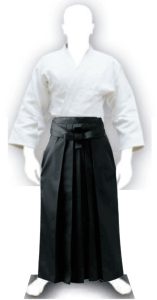 Also, wearing a hakama carries a secret philosophy. This means that foot movements are very important in Aikido. So that the correct execution of a technique is highly dependent on the steps and foot movements, and it is assumed for art students and professors who have mastered these movements to somehow keep these techniques hidden from visitors. By wearing a hakama, the legs and the way they are positioned and the steps will be significantly invisible.
Hakama and its shape, like many Japanese principles, have a philosophy and meaning that it is necessary for art students who wear hakama to show more attention and adherence to this philosophy and principles. This philosophy is evident in the folds of the hakama, and each fold of the hakama has special meanings. The hakama has a total of seven folds, five folds in front and two folds in the back of the hakama.
The symbolic meaning of these folds is as follows:
The meanings of the 7 Chinese found in Hakama
YUKI: Courage, courage, bravery
JIN: merit, charity, benevolence
GI: Justice, honesty, trustworthiness
REI: Courtesy and respect, humility, obedience
MAKOTO: Honesty, sincerity, originality of being
CHUGi: Conscientiousness, loyalty, dedication
MEiYO: honor, dignity, dignity

